How to Start a Career in Animation After 12th: A Beginner’s Guide
Ever seen an animated movie, played a video game or visual effects movie and wondered about the visuals involved in...
40, Kalyan Colony, Opposite Gaurav Towers, Malviya Nagar, Jaipur, 302017
+91-7878504947, +91-9314962972
View in the Map
301, Shyam Anumkampa
Nr. Ahinsa Circle
Ashok Marg C-Scheme, Jaipur, 302001.
+91-9314962972, +91-6376970482
View in the Map
H-25-26, Subhash Nagar Shopping Centre, Near Jain Chest Care Center, Shastri Nagar, Jaipur, 302016.
+91-9314962972, +91-8302708994, +91-9568245350
View in the Map
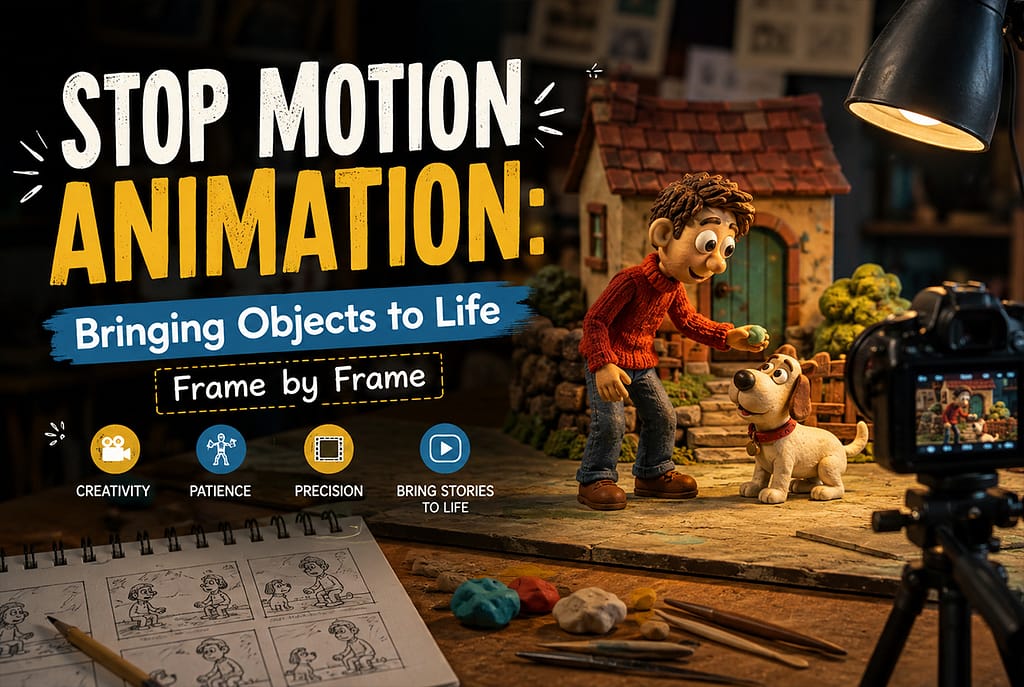
Animation is one of the most creative methods of visual storytelling. While contemporary animations involve sophisticated software and technology, some forms of animation have a totally different method of generating movement.
One of the most interesting methods of animation is stop motion animation.
Stop motion animation is a form of animation filmmaking that involves photographing physical objects by moving them incrementally by just a fraction of an inch per frame. Once all the shots are put in rapid sequence, the objects start moving independently of the camera or cinematography.
Anything from characters made of clay to miniatures, real-life objects and puppetry can be animated using this method.
Even though computer animation has become increasingly popular in 2D and 3D forms, the popularity of stop motion animation has not diminished due to its unique visuals, handcrafted quality and storytelling capabilities.
Students learning about animation, filmmaking, design and visual storytelling will benefit greatly from learning about this method.
Stop-motion animation is a method where physical objects are actually moved and photographed one frame at a time.
The typical process tends to be rather simple:
If all the pictures are put together and played fast, then the object will seem like it is moving.
For instance, assume that there is a figure made from clay which is walking on a table. An animator would move the leg of the figure a little bit, take a picture, then move it a little and take another picture.
Finally, when all the pictures are joined together, the character seems to be walking in a natural way.
The basic idea used in stop motion animation is almost the same as in other types of animations.
Motion is achieved by presenting a series of static images quickly.
Unlike the conventional 2D animation where the individual frames are drawn, in stop motion actual physical objects are used.
Steps involved in making an animation include:
Even an animated short may involve shooting hundreds or thousands of pictures.
The higher the level of fluidity desired, the more images the animator needs to make.
Stop motion animation is one of the oldest types of animation in the history of filmmaking.
Filmmakers have always tried out moving objects between still images in order to create various visual effects.
Before the invention of sophisticated computer-generated imagery technology, stop motion was extensively used to create characters and special effects in movies.
With time, various types of stop motion animation were invented based on:
While digital animation has revolutionized the entertainment industry, stop motion continues to be popular because of its unique style.
Today’s filmmakers blend the conventional approach of stop motion with digital methods of editing and special effects.
Stop motion animation can be made through the use of several different media.
Clay Animation, or claymation, uses characters and objects created using clay or substances that are similar in nature.
The animators manipulate the position and pose of the clay models in between the frames.
Clay animation is highly favored by the artists since they get to make expressive characters and movements.
In puppet animation, physical puppets are utilized, which are manipulated through each individual frame.
These puppets could consist of skeletal elements, which help manipulate the body positions of the puppet.
Uses of puppet animation include:
Object animation employs everyday objects to serve as animated subjects.
Toys, house items, office supplies, food packaging, and any number of physical objects may become animated using frame-by-frame motion.
This method is often employed for creative commercials and innovative animation projects.
In cut-out animation, two-dimensional figures or objects are created using paper, cardboard, pictures, or other media.
These are slowly shifted from frame to frame to give an illusion of motion.
It may be used for educational purposes, advertising, and narrative films.
Pixilation is an example of stop motion animation in which people are the subject matter.
Unlike stop motion where objects or figures move continuously through each photograph, the person assumes a different position in each photograph taken.
The movement of the person seems weird when the frames are played quickly.
Planning and preparation are needed in making stop-motion animations.
Every animation begins with a concept.
The concept will determine:
Planning is crucial when making stop-motion films since there usually has to be the construction of actual set pieces and objects beforehand.
The script determines the storyline and order of events.
It can have:
Having an obvious script helps in organizing the animation process.
Storyboard provides a visualization strategy for the animation.
This includes determining:
It will take less time during production if the storyboard assists animators to prepare for the scene.
Stop motion characters are tangible objects.
Based on the animation method, characters can be made out of:
The character design should be such that the characters can be positioned at different places without changing their shape.
Stop-motion utilizes small-scale sets in many instances.
Some of these sets may contain:
Set design is key to establishing a credible visual reality.
Lighting needs to be consistent during the entire process.
Stop-motion sequences are shot for a prolonged period, thus inconsistent lighting could alter the final result.
Artificial lighting is controlled by animators to ensure consistency.
This is the most critical stage of stop-motion animation.
The artist positions the object minutely and takes a photo, which is then repeated.
Every positioning should be thought out.
An error at this stage will affect the smoothness of the animation.
All frames will then be assembled through editing software.
Other components might include:
The final animation is then exported in the required video format.
Despite the use of physical objects in stop-motion, many principles of animation remain relevant.
The timing of something will determine how quickly or slowly an action is performed.
How many frames there are for an action to occur will influence how fast it happens and the emotions that come along with it.
Spacing
The space will refer to the difference in space that an object occupies from one frame to another.
Good spacing makes the movement look believable.
Anticipation
Sometimes, characters will do something before performing an action.
For instance, puppets are seen bending their knees before jumping.
This will make it more believable.
Squash and Stretch
Flexible objects like clay can be stretched and squashed.
Squash and Stretch gives animation more energy and personality.
Follow Through
In some cases, the hair, clothes, or accessories may still move even when the character comes to a stop.
Stop motion animation can be anything from a basic project done at home to something that is done professionally.
Some basic materials may include:
Advanced cameras, rigging and motion-control machines, and computer-based software may be employed in professional shoots.
The use of digital technologies may simplify this process.
Software widely used for stop motion is:
These techniques may assist animators in capturing frames, managing sequences, editing footage, and incorporating post-production effects.
Stop motion animation demands a variety of abilities.
Creativity
Animators require creativity for storytelling and character design.
Attention to Detail
Details between different frames may make an impact on the end result of the animation.
Patience
Stop motion animation can be a lengthy process.
Even several seconds of smooth animation can consist of hundreds of separate frames.
Knowledge of Movement
An understanding of timing, weight, balance and movement is necessary.
Photography
Knowledge of camera angles and framing is important.
Problem-Solving Skills
Physical models and sets may cause some problems.
Creative solutions are required from animators.
Stop motion animation is utilized in numerous industries that are involved in creating something.
Film and Entertainment Industry
Stop motion has been widely applied for making animated movies, short films and TV projects.
Its artistic visuals give productions an individual look.
Advertising Industry
The use of stop motion in advertising helps brands create catchy and memorable ads.
Product presentations and creative campaigns can be made with help of stop motion techniques.
Social Media Content
Videos with stop motion technique are commonly found in digital world.
Stop motion allows adding creativity to moving objects in social media videos.
Education
Stop motion can be used in order to explain some concepts and illustrate educative stories.
Music Videos
Some artists and production companies make music videos with stop motion.
Stop-motion animation is different from 2D and 3D animations in that it utilizes tangible objects.
| Stop Motion Animation | 2D Animation | 3D Animation |
| Uses physical objects and models | Uses flat drawings or digital illustrations | Uses three-dimensional digital models |
| Objects are moved manually | Movement is created through drawings or digital tools | Movement is created using 3D software |
| Captured using cameras | Created digitally or traditionally | Created entirely in a digital environment |
| Has a handcrafted visual appearance | Can have traditional or modern styles | Often creates realistic depth and space |
Different types of animation have their own merits and uses.
Knowing about different types of animations will definitely expand students’ knowledge about the animation field.
Animators and professionals skilled in stop motion have many options available in various creative industries.
Career possibilities might be:
Professionals may work with:
There are also chances for animators who wish to create advertisements, social media content, short films, and other innovative stuff through freelancing.
Stop motion animation provides an exciting blend of techniques such as animation, film-making, photography, design, and story-telling.
Stop Motion Animation will help students understand:
In addition, it promotes creative thinking since animators work with tangible things.
For students who are attracted to various aspects of creative production, stop-motion is an excellent form of practical education.
Technology has had an impact on the production process of stop motion animation.
Today’s stop motion works can include traditional animation alongside:
The basic process, however, has remained the same.
Objects are still manually relocated and filmed one frame at a time.
The craftsmanship of this process ensures that stop motion has a distinct identity which digital animation cannot fully copy.
With audiences appreciating original and unique material, the stop motion animation will maintain its significance within the animation industry.
It is clear from stop motion animation that creativity is not restricted to computers and digital software alone.
By using imagination and artistic abilities, anything can be turned into an animated story.
There are many skills that students who are studying animation may learn from this process, such as:
In Arena Animation Jaipur, students have the option of gaining creative insights through courses in Animation, VFX, Motion Graphics, Graphic Design, Multimedia, and Digital Content Creation.
Gaining proficiency in creative basics alongside skills in the use of industry-specific tools will go a long way in preparing students for the animation industry and related fields.
Conclusion
Stop motion animation can be regarded as one of the most creative and unique styles of animation because of its possibility to turn simple objects into a character and an interesting story through their movement on the screen.
From clay animation, puppetry to object animation and advertisement, stop motion is full of different creative possibilities.
Even though today’s technology provides more sophisticated forms of animation, stop motion animation remains unique due to its handmade style and artistic value.
For those students, who are interested in animation, film making, photography, design and narration, stop motion animation can become a great source of creativity and knowledge on how the animation works.
With creativity, patience, technical background and animation skills, anyone can enjoy the unique opportunities offered by this dynamic field.